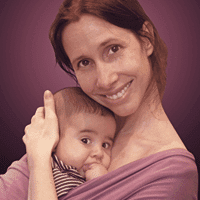
In this blog piece, we invite you to read an interview with Vanina Schoijett from Argentina. Vanina is a nurse specialized in breastfeeding support. She also accompanies families in other parenting issues and has authored several books on breastfeeding, sleep, and parenting.
In the sleep series, as you might have read in our previous pieces, we present different approaches regarding the issue of sleep, without necessarily endorsing one in particular but with the intention of giving parents a variety of perspectives on the issue.
Why is sleep such a controversial topic among parents?
Sleep deprivation is a big issue for most people. When you are about to have a baby, the world makes sure you learn that “you won’t sleep for years“, but having the actual experience can be overwhelming for many families. I believe lack of sleep is also amplified by Western cultural expectations about babies and little children’s normal sleep. Since the 70’s we have been told that a baby should be able to sleep through the night by the age of 6 months on average and if not, that means your baby has a sleeping problem. The truth is that most babies wake up several times at 6 months and will keep on doing it for many months and even years. Parents are usually concerned also about their child’s health, wondering if he/she’s having a real sleep problem that will affect their development and their future sleep. That’s when sleep training methods find the crack to slip in: families’ desperation.
In the past, health care professionals openly recommended techniques such as “cry-it-out” or “controlled crying” to supposedly teach young babies and children to sleep properly. Today we are surrounded by countless sleep trainers that claim to be kind and respectful of babies’ needs but in the end, the proposals are always the same: to crack the baby by letting her/him cry until she/he will no longer expect the parent to help them to go back to sleep, which is totally normal and has always been a normal parenting behaviour since we existed as a species.
What are your general ideas about the topic?
Babies’ sleep structure is very immature from birth. It will develop naturally during the first years and will reach an adult-like architecture by the age of 6 years. So we expect babies and little children to wake at night, more or less frequently, depending on the development stage they are going through at that particular time. During the first years, most kids need an attachment figure to help them go back to sleep by feeding, patting, rocking or whatever resource the adult finds helpful. This is just normal, and families should be educated about this issue to have realistic expectations and choose the most sustainable ways to go through those first years. Evolution says that breastfeeding and co- sleeping (sharing the sleeping place with our child) have been the most efficient tools we used for millions of years. And while society has evolved, babies’ and children’s needs are the same as those of our ancestors.
What are the main elements in your approach?
I will say that empathy, understanding, information, and ideas are a core part of the help I provide to families. I focus on knowing the families characteristics, routines, daily activities, children particularities (age, feeding, motor skills, health issues, etc.) to see if there is something that could be adjusted to improve sleep, always respecting the children’s needs and educating adults about the relation between sleeping and their children’s developmental stage.
What are the common challenges parents/your clients face when trying to put their babies to sleep?
I believe high expectations and over-information are usually making it difficult for the parents to follow children’s sleep needs from a realistic point of view. Social media is flooded with information about “how babies should sleep”, which simply doesn’t match what actually happens at home. Our culture pushes parents to believe that they should teach their babies how to self-comfort, sleep alone, to “be independent”, missing out that children need proximity and physical contact to grow, to feel safe, and to be independent… later on. When parents try to fight that and insist on “teaching” the baby to sleep as an adult, they all -parents and children- end up frustrated, and I think it’s sad the way mothers and fathers usually feel incompetent for not achieving the goal of having a baby that sleeps happily alone through the night at an early age.
One thing you would advise parents to keep doing while putting their babies/kids to sleep.
I’d suggest reading fewer books and blogs and connecting deeply with their babies’ needs. Children communicate with us pretty clearly, and we should be open to receiving their messages. Educating ourselves about sleep biology and physiology is crucial to understand why small children behave as they do, why they need us so much, and why it is very important to meet those needs. We are not creating monsters for listening and being there for our kids. By being responsive, sensitive, and loving, we’ll be just helping little people to develop as confident, respectful, and caring grown-ups, which I believe are most parents’ goals.
** In the sleep series, as you might have read in our previous pieces, we present different approaches regarding the issue of sleep, without necessarily endorsing one in particular but with the intention of giving parents a variety of perspectives on the issue. **